We studied coral reefs in French Polynesia and discovered that corals with four clearly separated clades of their symbiotic algae responded differently to temperature stress than those with mixed populations.
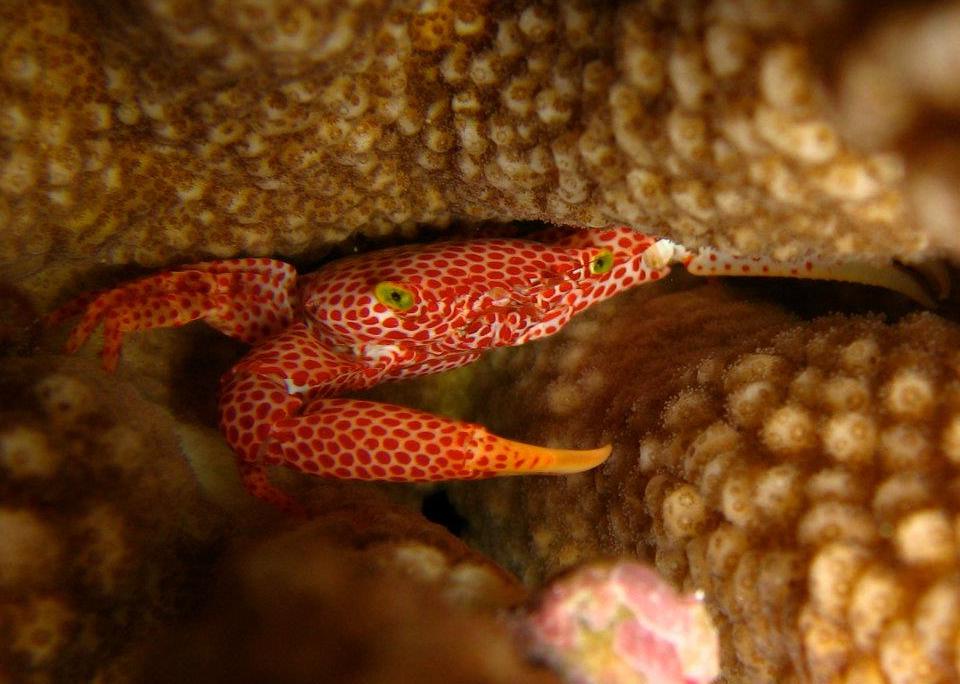
Over three consecutive days, we surveyed Pocillopora coral colonies, documenting every crab and shrimp they found. They then designed controlled experiments using outdoor seawater tanks, adding different combinations of the two most common species - Trapezia serenei crabs and Alpheus lottini shrimp - to corals before adding precisely measured amounts of sediment at dusk.
Our results showed clear benefits of multiple cleaner species. Alone, corals removed only 10% of the sediment. With two symbionts, removal jumped to 30%. With four symbionts, it reached 48%. Each additional cleaner contributed the same per-capita benefit regardless of how many others were present - they worked independently, not synergistically. In field surveys, Trapezia crabs and Alpheus shrimp co-occurred more often than expected by chance, and all common symbionts occurred only as pairs, never at higher abundances.
"While corals can remove some sediment through mucus sloughing and cilia movement, Our work shows that symbionts play a critical role in protecting corals from sedimentation damage."
The pairing pattern observed in nature was notable. Despite the clear benefits of having more cleaners, researchers never found more than two individuals of any species on a single coral. This suggests that intraspecific competition - likely related to mating systems - prevents higher densities.
These findings matter because sediment is a major threat to coral reefs worldwide. Natural disturbances like cyclones and human activities like coastal development increase sediment loads, which decrease coral growth and increase mortality. While corals can remove some sediment through mucus sloughing and cilia movement, Our work shows that symbionts play a critical role in protecting corals from sedimentation damage. The key insight is that coral health depends not just on having cleaners, but on maintaining diverse communities of different cleaning species.
As coral reefs face increasing threats, understanding these partnerships becomes important for predicting which reefs might survive and which conservation strategies might help them thrive.
Citation
Stier, Adrian C.; Gil, Michael A.; McKeon, C. Seabird; Lemer, Sarah; Leray, Matthieu; Mills, Suzanne C.; Osenberg, Craig W. (2012). Housekeeping Mutualisms: Do More Symbionts Facilitate Host Performance?. PLoS ONE.
This paper is Open Access.
Cite this article
Stier et al. (2012). Coral Housekeepers: Multiple Species of Cleaners Keep Reefs Sediment-Free Better Than Any Single Species. Ocean Recoveries Lab. https://doi.org/10.1371/journal.pone.0032079