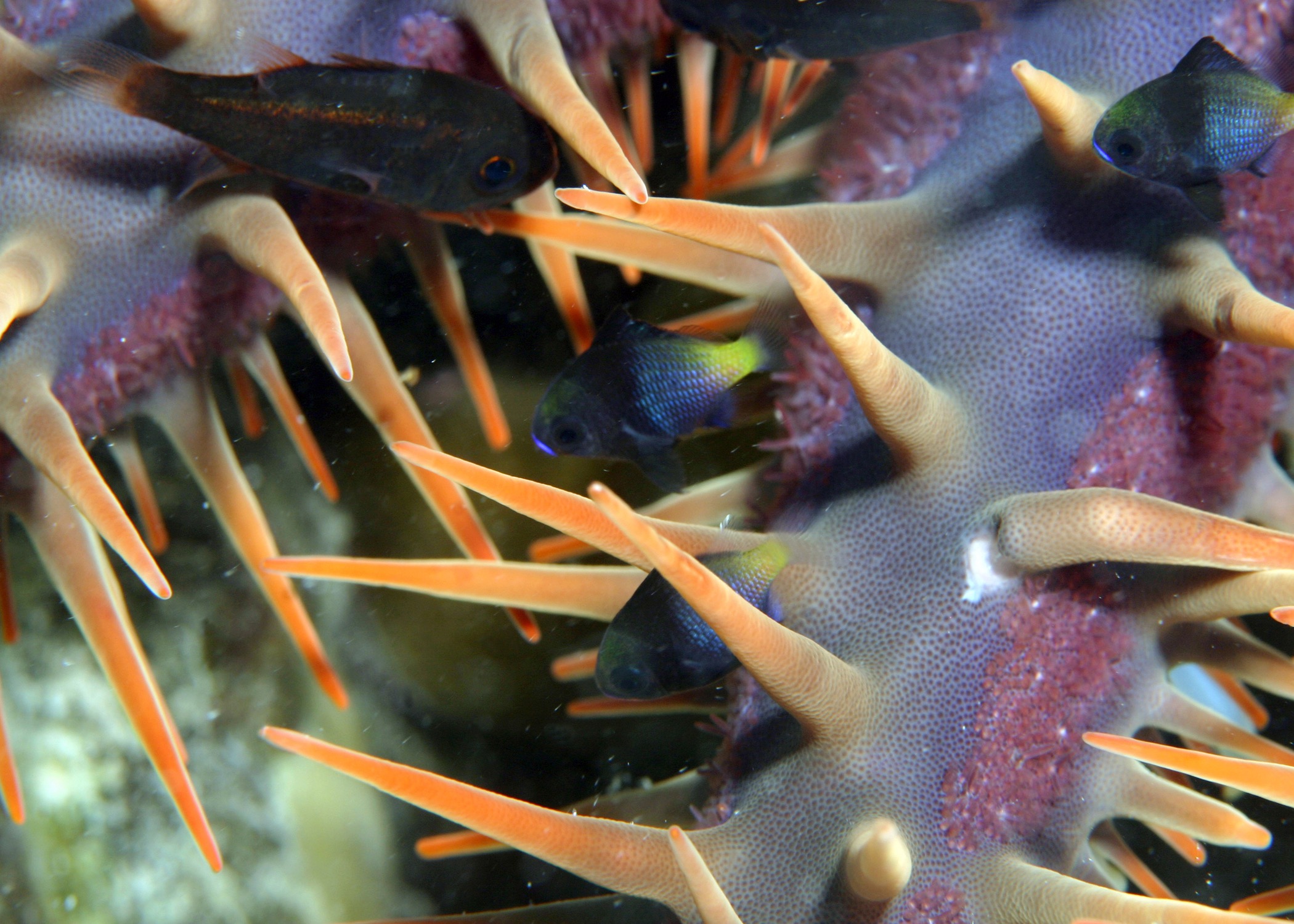
We documented reef fish using crown-of-thorns starfish as habitat. While surveying starfish in Moorea, we repeatedly observed small fish sheltering among the venomous spines. The creature famous for destroying coral habitat was serving as habitat itself.
Crown-of-thorns seastars devastate reefs—their outbreaks leave bleached coral skeletons across the Pacific. Yet small juvenile fish were darting in and out of the deadly spines like they'd found a mobile shelter. The irony compounds: as the starfish eats coral and destroys fish habitat, it becomes temporary replacement habitat. The venomous spines that make crown-of-thorns dangerous provide a defensive barrier that tiny fish exploit.
Small juveniles dominated the fish we documented associating with starfish—exactly the size class most vulnerable to predation in open water. They stayed among the spines rather than fleeing across open substrate when approached.
Ecological reality resists tidy narratives of villains and victims. The destroyer also provides services. This matters less for practical management—nobody will cultivate crown-of-thorns as fish habitat—than for understanding that reef ecosystems involve complexity that defies simple stories.
Citation
Stier, Adrian C.; Steele, Mark A.; Brooks, Andrew J. (2009). Coral reef fishes use crown-of-thorns seastar as habitat. Coral Reefs.
This paper is Open Access.
Cite this article
Stier et al. (2009). Coral's Worst Enemy Also Serves as Fish Shelter—Nature's Irony. Ocean Recoveries Lab. https://doi.org/10.1007/s00338-008-0445-9