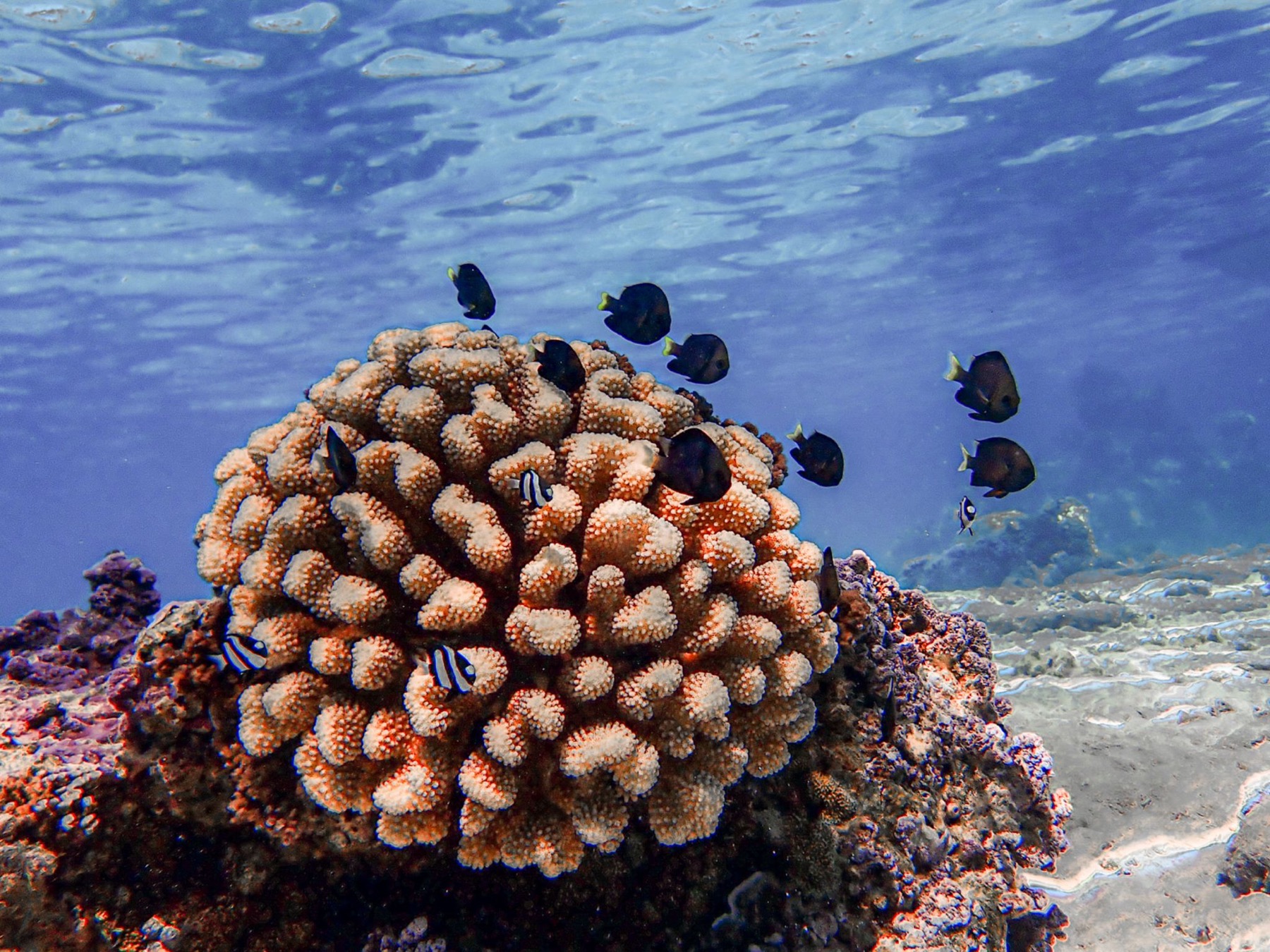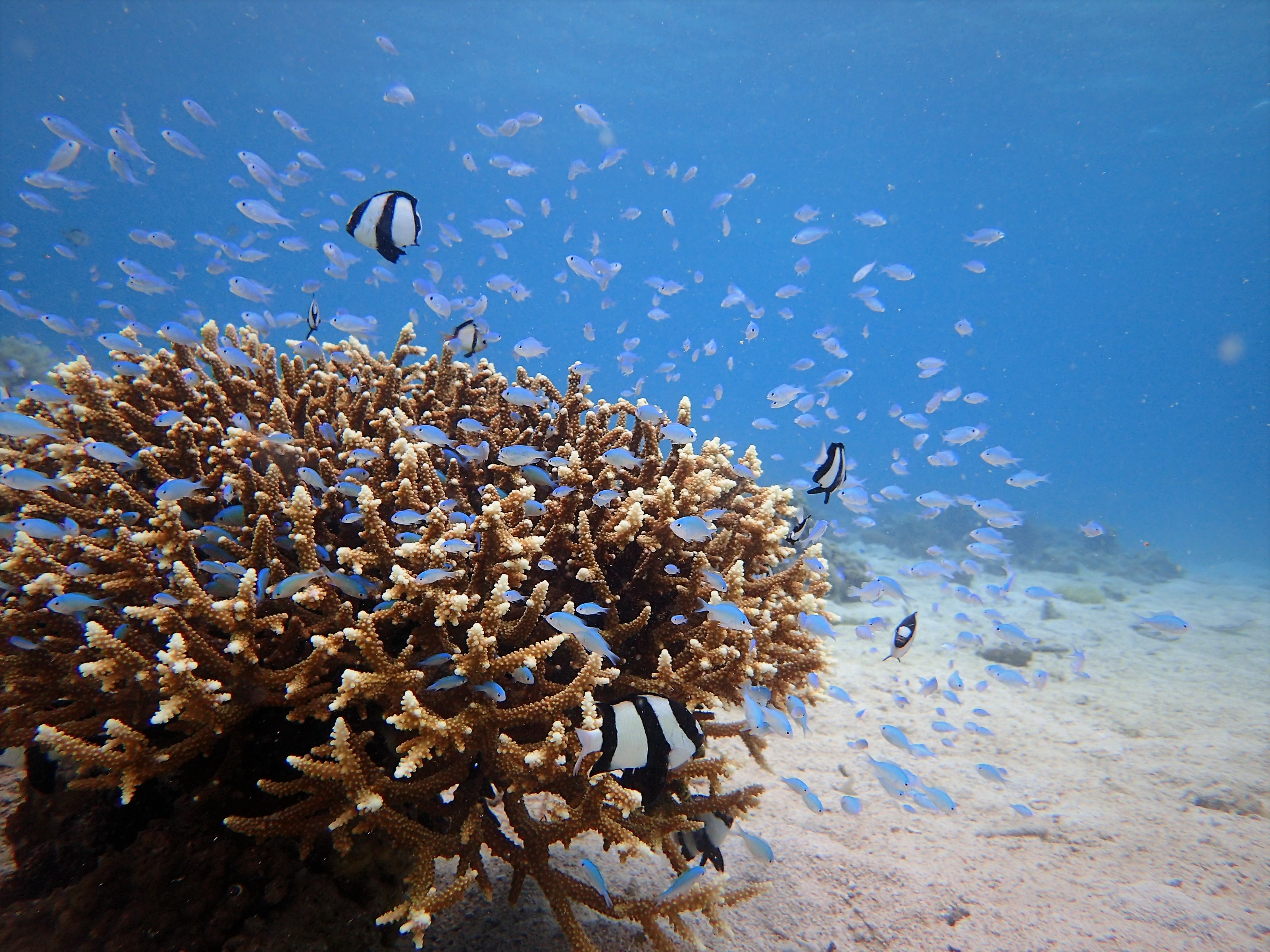
Our field experiment in French Polynesia revealed surprising results about how coral colonies benefit from their resident fish. we built 32 concrete experimental reefs in an open sand plain, far from natural reefs to avoid confounding factors. On each reef, they transplanted small Porites colonies - some reefs received just two colonies, others received eight. Half of the experimental reefs were caged to keep predators out, half were left open with partial cages that allowed fish access.
The results were striking. Predator exclusion increased coral growth by 20%, which aligned with expectations. But the bigger surprise was density: corals in high-density treatments grew 30% faster than those in low-density treatments. We never observed actual bite marks on experimental corals, suggesting the predation effects came from the metabolic cost of tissue repair rather than obvious skeletal damage. Meanwhile, fish surveys confirmed that high-density reefs attracted significantly more corallivorous fish.
What proved most interesting was that these two effects - density and predation - operated completely independently. If predator dilution explained the density benefit, the effect should have disappeared in caged treatments. It didn't. The mechanism behind the density benefit remains unclear. We suspect it involves changes in water flow around coral colonies, which could boost photosynthesis or nutrient uptake, or perhaps the increased abundance of beneficial organisms that associate with coral colonies.
"Our field experiment in French Polynesia revealed surprising results about how coral colonies benefit from their resident fish."
Our research has implications for coral restoration strategies. If corals benefit from clustering, then efforts to rebuild damaged reefs should consider density as a factor. It also suggests that as reefs decline and coral cover drops, the remaining colonies might face additional stress from the loss of density-dependent benefits.
Fundamental questions remain about what drives these density benefits and how dense colonies need to be to gain advantages. In an era of reef decline, understanding whether the loss of coral neighborhoods creates cascading effects becomes increasingly important for conservation efforts.
Citation
Shantz, A. A.; Stier, A. C.; Idjadi, J. A. (2011). Coral density and predation affect growth of a reef-building coral. Coral Reefs.
Cite this article
Shantz et al. (2011). Coral Safety in Numbers: Reef-builders Grow Faster in Dense Neighborhoods Despite Attracting More Predators. Ocean Recoveries Lab. https://doi.org/10.1007/s00338-010-0694-2