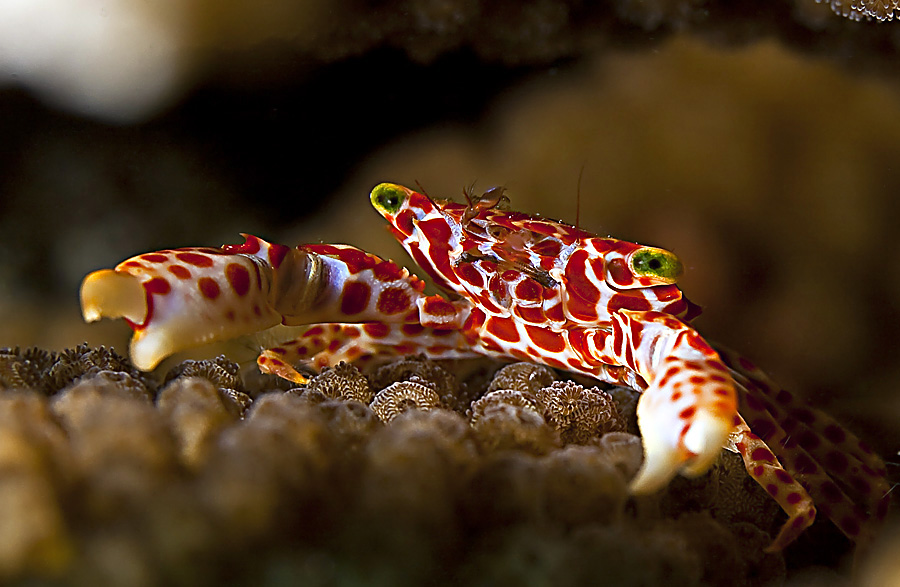
The guide explains how small coral guard crabs (Trapeziidae family) protect their coral hosts from predators and sediment, creating a mutually beneficial relationship that helps maintain coral reef ecosystems. The review synthesizes existing research on Trapeziid crabs and their relationships with corals, drawing on field observations and experimental studies of crab defensive behaviors and coral survival. Trapeziid crabs actively defend their coral hosts against predators like crown-of-thorns sea stars and corallivorous snails by attacking them with their claws. The crabs also act as housekeepers, removing sediment from coral surfaces that could otherwise kill the colony. When researchers remove crabs from corals in high sedimentation areas, the corals die, but corals with crabs present survive. Climate change experiments show increased water temperature reduces crab abundance and egg production, and causes crabs to expel their mates. Understanding these crab-coral partnerships shows how small organisms can have outsized effects on coral reef resilience, and shows how climate change could disrupt these protective relationships, potentially accelerating coral reef decline.
Citation
Stier, Adrian C.; Osenberg, Craig W. (2024). How fishes and invertebrates impact coral resilience. Current Biology.
Cite this article
Stier et al. (2024). How Fish and Crabs Work Together to Keep Coral Reefs Healthy. Ocean Recoveries Lab. https://doi.org/10.1016/j.cub.2024.05.071