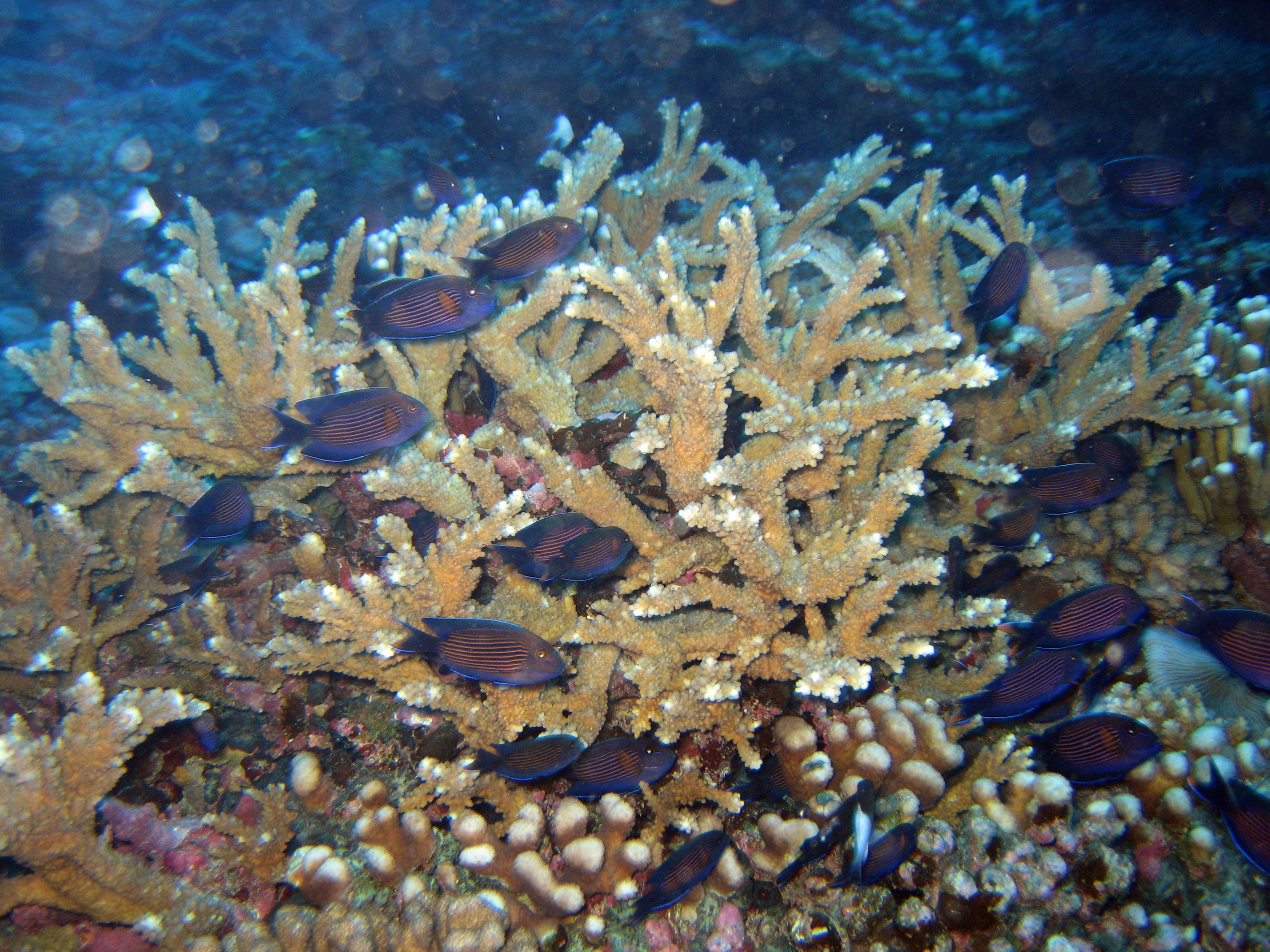
We witnessed something extraordinary in February 2006 in the lagoons of Moorea: striped bristletooth surgeonfish had arrived as juveniles in an episodic settlement event. Within days, hundreds of these fish were lying dead on the sandy bottom, their bodies marked by distinctive white lesions.
We had been tracking fish populations around this French Polynesian island for years, conducting biannual surveys at 26 sites to estimate fish abundance and size. Our data showed recruit densities were more than six times higher during the February events of 2006 and 2009 compared to typical counts of about 3 recruits per 50 square meters. But the aftermath was unlike anything described in the literature.
Instead of finding evidence of predation, we documented fish lying dead or dying with large white lesions, particularly near their tails, along with decreased swimming ability and tattered fins. Most telling was what we didn't see: predators weren't immediately consuming the dead and dying fish, suggesting they may have been satiated or avoiding diseased prey.
What struck us was the apparent selectivity of whatever was killing these fish. Only the surgeonfish showed symptoms, despite the lagoon being full of other species that should have been equally vulnerable to predators or environmental stressors. Both die-off events coincided with blooms of Lyngbya majuscula, a toxic cyanobacteria known to cause surgeonfish toxicity in Hawaii, but we had no way to test whether this was the culprit or coincidence.
Our observations matter because they challenge a fundamental assumption about reef fish population dynamics. If disease outbreaks, rather than predation, drive mortality during recruitment pulses, it could change how we think about population bottlenecks and community structure on coral reefs.
Citation
Stier, Adrian C.; Idjadi, Joshua A.; Geange, Shane W.; White, Jada-Simone S. (2013). High Mortality in a Surgeonfish Following an Exceptional Settlement Event. Pacific Science.
Cite this article
Stier et al. (2013). Mystery Disease Kills Hundreds of Fish After Rare Ocean 'Baby Boom' in French Polynesia. Ocean Recoveries Lab. https://doi.org/10.2984/67.4.4