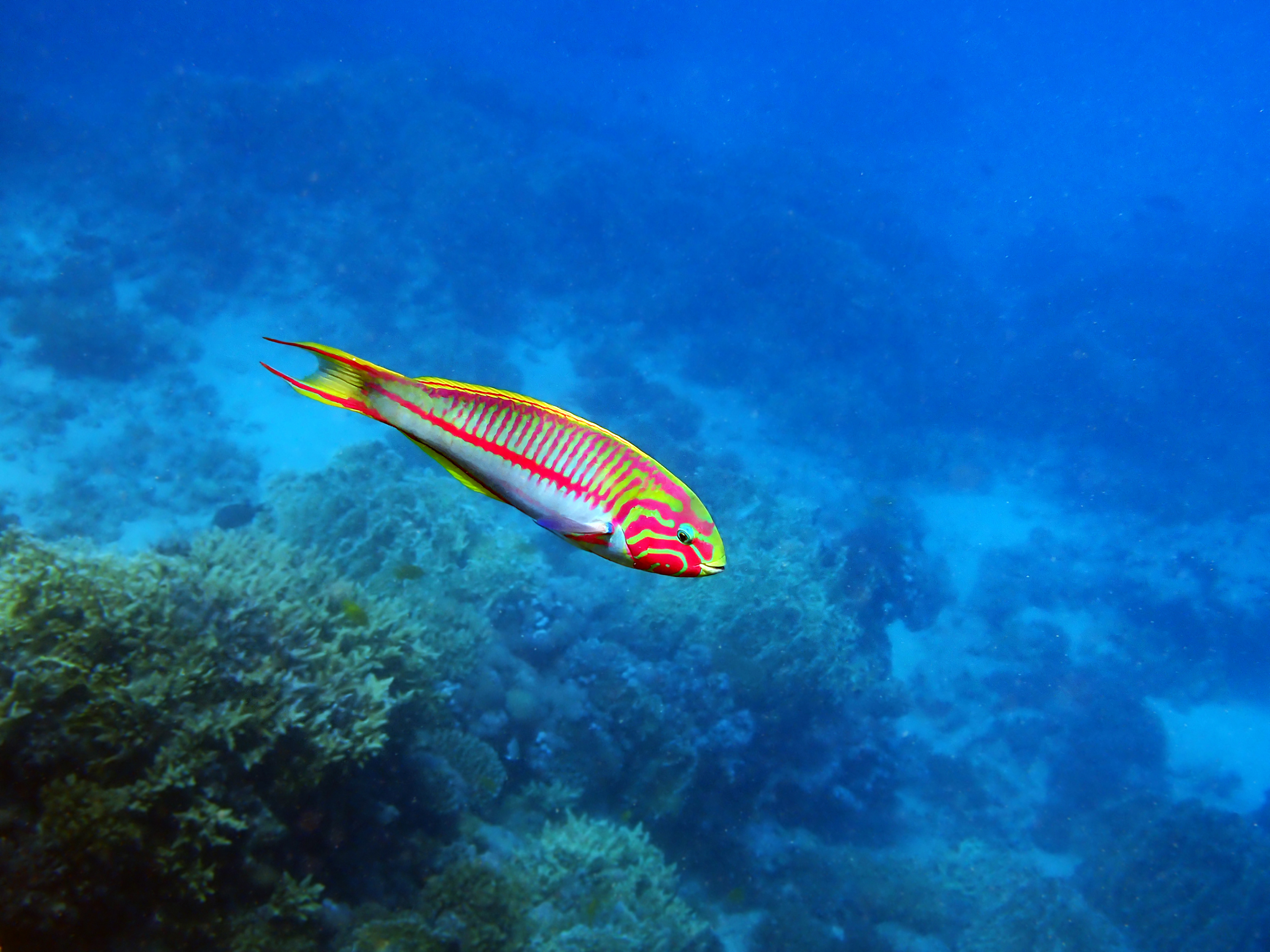
We investigated whether competition between multiple species follows predictable mathematical patterns. Research by Shane Geange, Adrian Stier, and Jeffrey Shima tested this question among juvenile coral reef wrasses.
We set up pairwise competition experiments on experimental reef patches in the tropical Pacific. They placed juveniles of three Thalassoma wrasse species in different combinations and monitored survival and growth over time. By comparing outcomes across all possible species pairs, they could determine whether competition followed a linear hierarchy or a more complex network.
Our results revealed a clear competitive hierarchy. One species consistently dominated, reducing survival and growth of both other species in pairwise trials. The middle-ranked species similarly outcompeted the lowest-ranked species. This linear ordering persisted across different experimental conditions.
This matters because hierarchical and intransitive competition have different implications for species coexistence. Intransitive competition, where species form a competitive loop, can promote diversity because no single species can dominate everywhere. But strict hierarchies concentrate competitive advantage in one species, potentially leading to exclusion of weaker competitors unless other factors intervene.
On natural reefs, the competitively inferior species still persist alongside the dominant one. This suggests that factors besides direct competition, like habitat partitioning, predation pressure, or variable recruitment, allow weaker competitors to find niches where they can survive. The competitive hierarchy sets the baseline interaction, but the reef's complexity creates refuges.
Understanding these competitive relationships becomes increasingly important as reef conditions change. If climate change or disturbance shifts the balance among these factors, the underlying competitive hierarchy could become more determinative of community composition. Species that currently persist despite competitive inferiority might lose the buffers that allow their coexistence.
Citation
Geange, Sw; Stier, Ac; Shima, Js (2013). Competitive hierarchies among three species of juvenile coral reef fishes. Marine Ecology Progress Series.
This paper is Open Access.
Cite this article
Geange et al. (2013). Pecking Order on the Reef: Competition Among Baby Wrasses Follows Strict Hierarchy. Ocean Recoveries Lab. https://doi.org/10.3354/meps10015