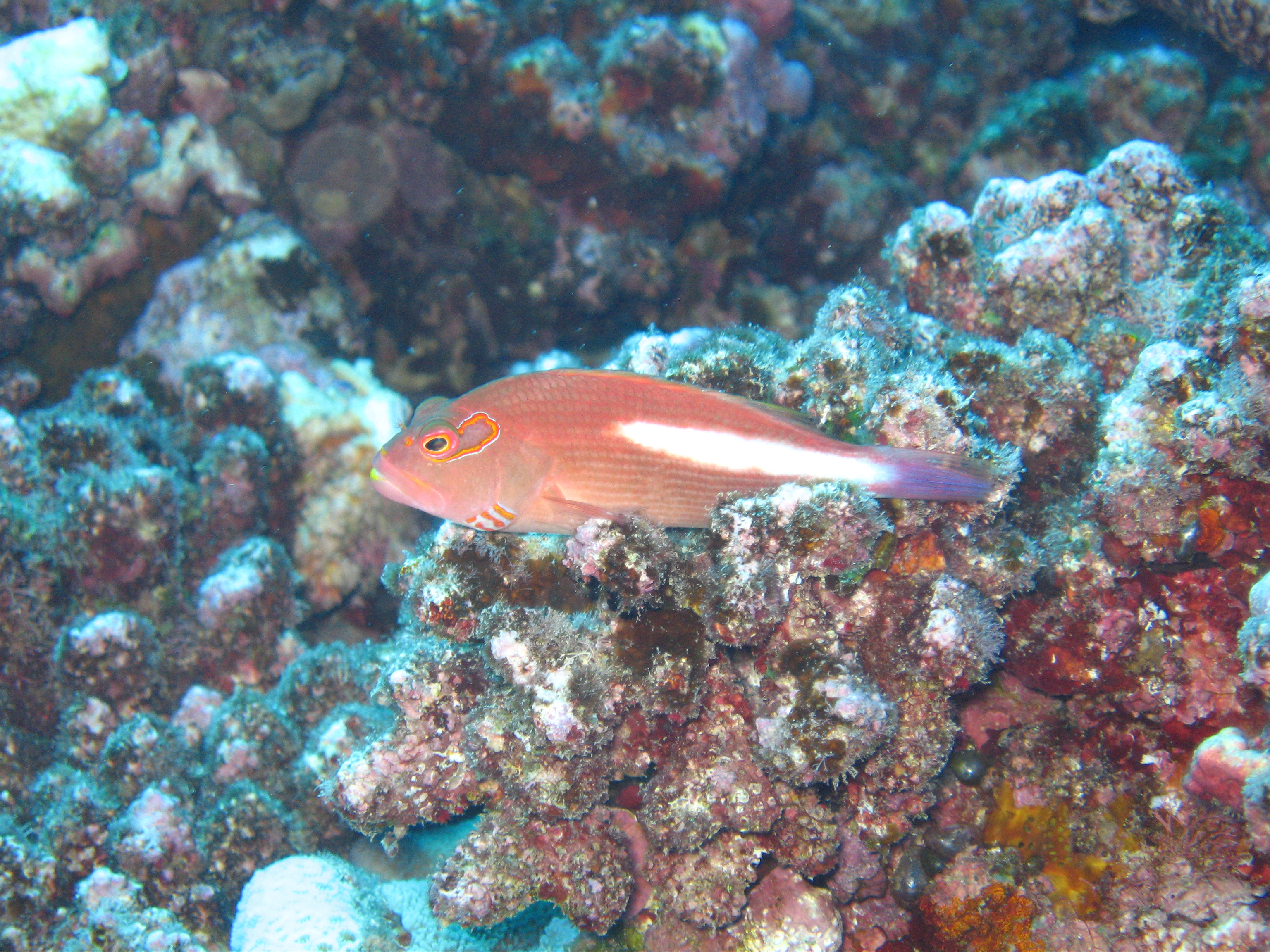
We studied hawkfish hunting behavior on coral reefs and expected larger predators to studying hawkfish hunting behavior on coral reefs expected larger predators to have stronger effects on prey populations. These arc-eye hawkfish are ambush predators commonly observed perched on coral branches, and larger predators generally have higher consumption rates due to their larger mouths and experience. Gallagher, Brandl, and Stier tested whether body size within a single predator species actually changes how that predator affects its prey community.
We combined two approaches on the shallow back-reefs of Moorea. First, they conducted 27 underwater surveys along 50-meter transects, recording which coral heads housed hawkfish and noting whether prey fish like blue-green chromis and yellowtail damselfish were present. They classified hawkfish into small (4 cm or less) and large (more than 4 cm) categories based on the bimodal size distribution observed. Then they brought the question into the lab, collecting 22 hawkfish and 80 small chromis for controlled feeding experiments in circular tubs with coral rubble.
The results were striking in their consistency. In the field surveys, both small and large hawkfish were associated with lower chances of prey fish being present on coral heads, but these effects were independent of predator size. The laboratory experiments corroborated this pattern - attack rates were indistinguishable between small and large hawkfish. Whether looking at high prey density (six fish), medium density (four fish), or low density (two fish) treatments, hawkfish size didn't predict consumption rates. The presence of any hawkfish, regardless of size, created what appeared to be a 'risky' environment that prey fish avoided.
"The results were striking in their consistency."
The size-independence proved robust across different experimental conditions. We had deliberately chosen quite different size classes for lab work - small hawkfish under 4 cm versus large ones over 9 cm - expecting this wider gap to reveal size-dependent effects. Yet even with this pronounced size difference, the functional responses remained remarkably similar.
These findings matter because coral reefs worldwide are experiencing dramatic shifts in predator communities. Fishing pressure disproportionately removes large-bodied predators while potentially releasing smaller mesopredators from competition. Our research suggests that these smaller predators might maintain significant ecological influence despite their reduced stature. This could mean that ecosystems retain more predation pressure than expected based on size alone, though whether small predators can truly compensate for the loss of large ones across all ecological functions remains an open question.
Our results indicate that variation in predator size-structure alone may not always affect the functional role of these predators. Understanding how natural and anthropogenically induced variation in predator size affects the dynamics, structure and stability of coral reef communities remains critical as marine ecosystems continue to experience changes in species composition and size structure.
Citation
Gallagher, Austin J.; Brandl, Simon J.; Stier, Adrian C. (2016). Intraspecific variation in body size does not alter the effects of mesopredators on prey. Royal Society Open Science.
This paper is Open Access.
Cite this article
Gallagher et al. (2016). Size Doesn't Always Matter: Small Coral Reef Predators Pack Same Punch as Large Ones. Ocean Recoveries Lab. https://doi.org/10.1098/rsos.160414