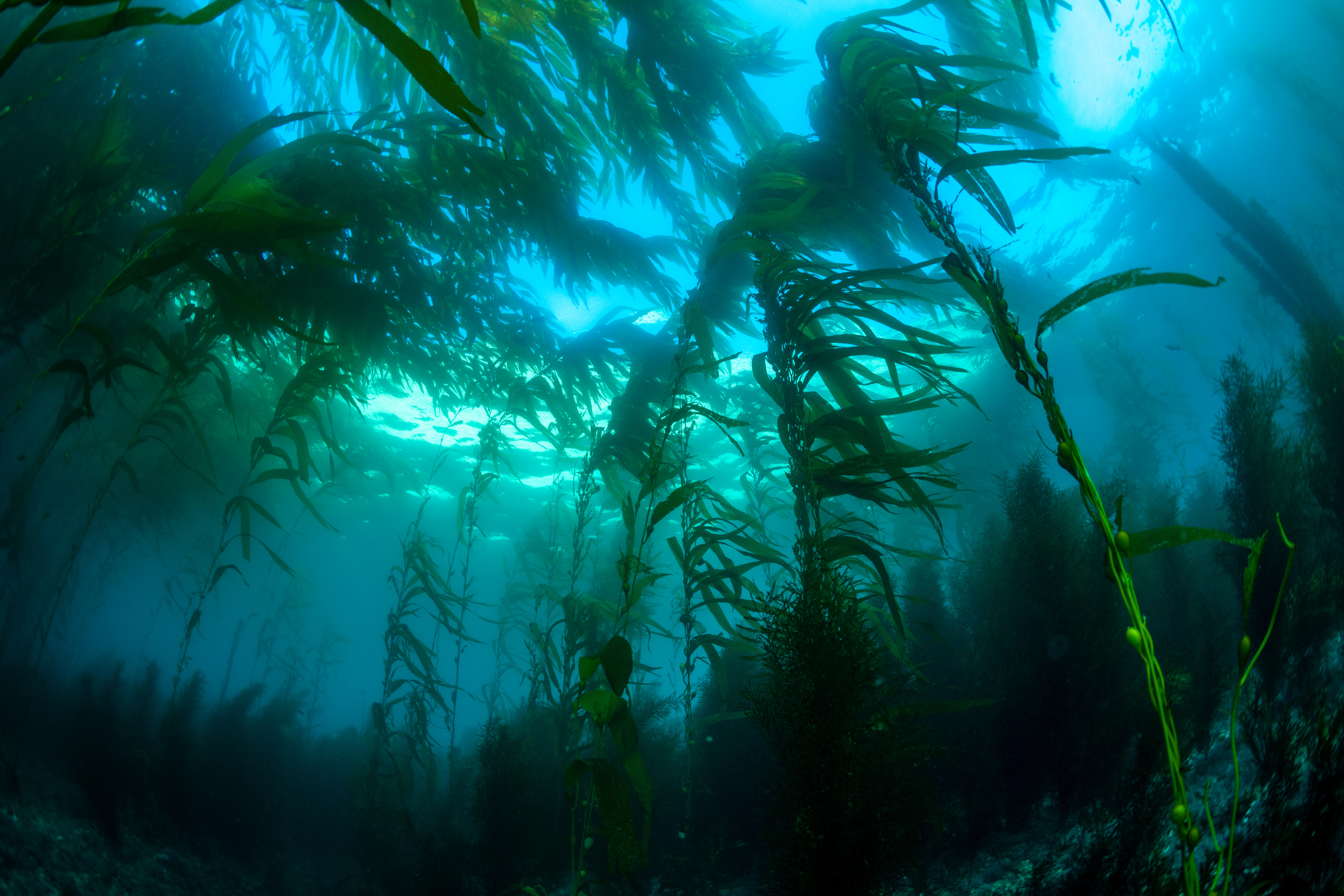
Researchers developed a mathematical model to understand how storm intensity affects giant kelp forests and the underwater communities that depend on them, finding that severe storms lead to more understory algae and fewer sessile animals on the seafloor. The researchers built a mathematical model that simulates giant kelp population dynamics through different storm scenarios, then tracked how changes in kelp abundance affected competition between understory algae and sessile invertebrates for space on the seafloor. They validated their model predictions against 20 years of real community data from California kelp forests. Severe storm regimes resulted in greater abundance of understory macroalgae and lower abundance of sessile invertebrates compared to milder storm regimes. Both the cascading effects of giant kelp loss and direct storm scouring of the benthos influenced competition outcomes between community members. The model's qualitative predictions were consistent with empirical data from a 20-year time series of community dynamics. Dense kelp canopies can reduce light reaching the benthic community by up to 90%. The research shows how variations in storm disturbance regimes can fundamentally alter kelp forest ecosystems by shifting which organisms dominate the seafloor. Understanding these cascading effects through foundation species is important for predicting how changing disturbance patterns may impact marine community structure.
Citation
Detmer, A. Raine; Miller, Robert J.; Reed, Daniel C.; Bell, Tom W.; Stier, Adrian C.; Moeller, Holly V. (2021). Variation in disturbance to a foundation species structures the dynamics of a benthic reef community. Ecology.
"Understanding these cascading effects through foundation species is important for predicting how changing disturbance patterns may impact marine community structure."
Cite this article
Detmer et al. (2021). Storm Disturbance Can Reshape Kelp Forest Communities. Ocean Recoveries Lab. https://doi.org/10.1002/ecy.3304