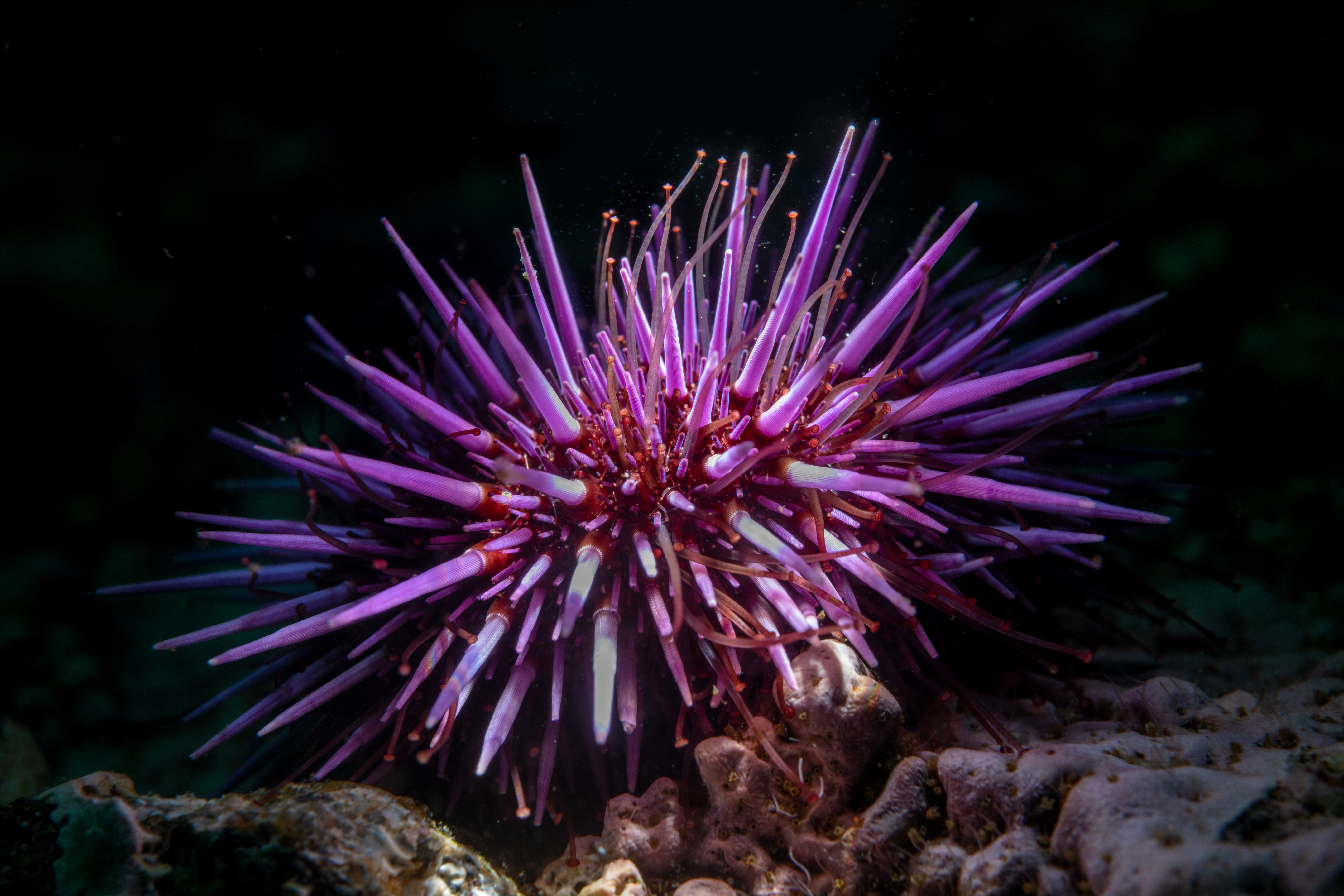
Researchers studied how purple sea urchin behavior and size affect their survival when faced with California spiny lobster predators, finding that smaller, more active urchins are most vulnerable to being eaten. The team collected 170 purple urchins and 3 spiny lobsters from California waters, tested individual urchins for activity levels and covering behavior, then placed groups of 4 urchins with a single lobster in mesocosms for 108 hours to see which ones survived. High activity level was negatively associated with urchin survival; more active urchins were more likely to be eaten. The negative effect of activity on survival was strong for smaller urchins but weaker for large urchins. Urchin size alone and covering behavior alone did not independently influence survival. Individual urchins showed consistent behavioral differences over time in both activity and covering behavior. The research suggests that recovering lobster populations could selectively remove certain urchin types from populations, potentially altering kelp forest stability. Since urchins can consume large quantities of giant kelp and drive ecosystem shifts between kelp forests and urchin barrens, understanding which urchins survive predation could help predict when these important 'tipping points' occur.
Citation
Pretorius, Justin D.; Lichtenstein, James L. L.; Eliason, Erika J.; Stier, Adrian C.; Pruitt, Jonathan N. (2019). Predator‐induced selection on urchin activity level depends on urchin body size. Ethology.
This paper is Open Access.
Cite this article
Pretorius et al. (2019). Urchin Size and Behavior Shape Predation Risk. Ocean Recoveries Lab. https://doi.org/10.1111/eth.12924